Monday, July 7, 2025

The Abominable Dr. Phibes (1971) - Newspaper Ad [Oakland Tribune - July 7, 1971]


According to the venue listing at the bottom of this ad, the Coliseum Drive-In seems to have had only two screens at one point. I am going to guess that the third screen, which I will assume would be the one that had its back to 880 (aka the Nimitz Freeway) was added at some point in the mid-seventies. Because I remember the Coliseum Drive-In having three screens in 1976.

The Blair Witch Project (1999) - Trading Card #67

16mm Footage

October, 1995. University of Maryland Professor David Mercer, an anthropology instructor, was supervising a group of students on a field dig when a hidden backpack was discovered. Inside were 16mm film cans, DAT cassettes, a Hi-8, and a CP-16 camera, as well as a tattered journal. The footage was developed and screened by Sheriff Ron Cravens, providing what appeared to be hard evidence in the disappearance of the three students.

What this card's text does not mention, due to space constraints or an editorial decision, is that the backpack was discovered within the dig itself. I seem to recall one of the documentaries that aired prior to the film's opening that the backpack was discovered in an 'impossible' location, adding another layer of supernatural strangeness to the proceedings.

Friday, July 4, 2025

The Curse of the Werewolf - Newspaper Ad [San Francisco Examiner - July 4, 1990]


Every year we kick off the Christmas season by attending Smuin's Christmas Ballet. So my eyebrows shot up when I saw that Michael Smuin had directed this musical comedy-thriller that I had never heard of, despite my living in San Francisco at the time of its production. Not that I could have afforded a ticket. So it goes.

A little digging uncovered that The Curse of the Werewolf was a revival of 1976 'monster-melodrama' written by Ken Hill. The less than stellar review the Examiner critic gave this production, on June 15th, described Hill as an "English writer who takes public domain stories, redesigns them as spoofs, and sets them to public domain songs from long-forgotten operettas." Okay.

Despite having the same title as a 1961 Hammer Film production starring Oliver Reed and directed by Terence Fisher, The Curse of the Werewolf is not based off any pre-existing material. Hill himself heavily revised his script for this production, which also featured an all-new score.

In an Examiner article that appeared in the Sunday, June 10th Datebook, Smuin described the show as "somewhat reminiscent of Mel Brooks' Young Frankenstein, with a dash of Monty Python." 

As promising as that sounds, and as popular and successful as The Curse of the Werewolf was in Canada and England, it having been produced some 35 times from 1976 through to 1990, it seems this presentation had a struggle getting an audience.

Alien (1979) - Trading Card #64


After Nostromo crew members split into separate groups, Brett finally finds the Alien... or rather, it finds him. Now seven feet tall, the Beast swoops down on its prey like a gigantic bat!

In the theater of a card reader's mind, perhaps. But not in the actual movie, though.


The image used for this card was trimmed from the finished film, but it can be seen in a 'restored' edit that serves as an illustration as to why less is so often a lot more.


As much as I like the confusion, shock, and terror that Stanton expresses in the pause before the attack, where he tries to scream, but can only get out what sounds like a huff and a growl, is a nice touch. But the painful truth is that it just slows the scene down and dilutes the power of the Alien's first appearance.

Also the Alien is shown way too much before the attack in this version. Although it is nice to be able to see the scene the way it played when Jerry Goldsmith wrote the music for it, before the final edit was actually locked.

Thursday, July 3, 2025

The Car (1977) - Soundtrack


Leonard Rosenman's score for The Car was one that I had ached to have a soundtrack recording of for almost four decades. It took thirty-eight or so years for it to happen, but Intrada managed to secure a commercial release of Rosenman's atmospheric and kinetic music for The Car in 2015. Better late than never.

The brevity of the score, which runs a few seconds shy of a mere 34 minutes, might be one reason an album version was not released in 1977. Another could be Rosenman's choosing to score, for the most part, only scenes where the Car is either present or its the aftermath of an attack.

The lone exception to that latter reason are a few moments involving the character Luke (Ronny Cox) and his relapse into alcoholism. The remainder of the human drama and character moments are not scored and play out in an almost noticeable silence.

Jeff Bond, in his liner notes for this release, notes how "Rosenman's dissonant, agitated and aggressive soundscapes [were] a natural fit for horror and science-fiction movies." I both agree and doubt that there was a composer better suited for this material than Leonard Rosenman.

Another interesting and appropriate choice on Rosenman's part, in addition to not giving his score any human coloring, is his use of Dies Irae as the score's primary theme. Dies Irae, perhaps best known for its use in Stanley Kubrick's The Shining, becomes an auditory signature for the Car that is every bit as recognizable as its distinctive, and iconic, horn blasts.

Dracula - Newspaper Ad [Oakland Tribune - July 3, 1930]


While Universal's film adaptation of Dracula would not start shooting until the very end of September. There is a very real possibility that, at the time this traveling production of the Broadway play performed in Oakland, Bela Lugosi would have known that he had been cast to play Dracula in the film version.  

I'm also surprised to learn that Lugosi and the rest of the Broadway cast performed in Oakland. Go figure.

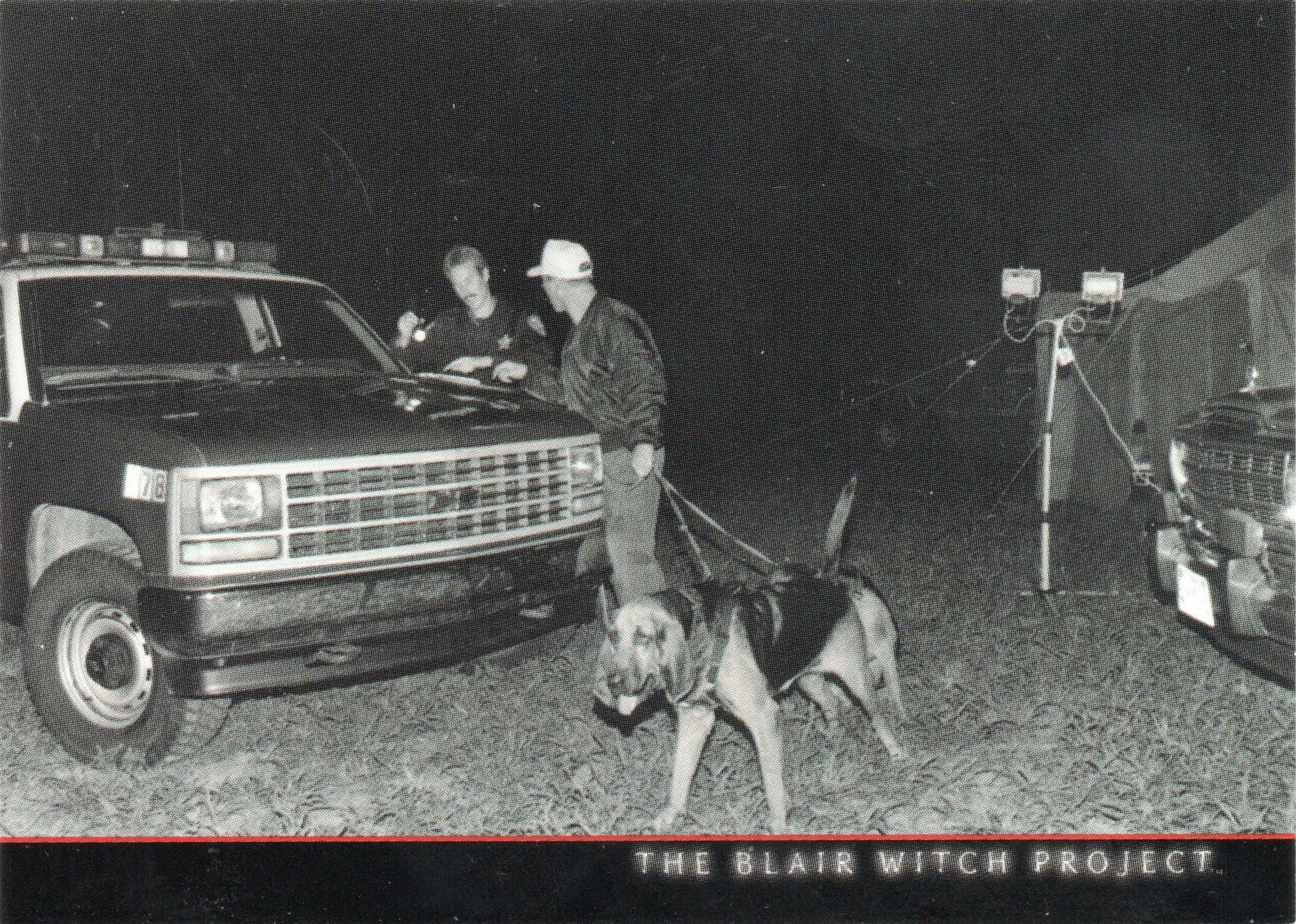
The Blair Witch Project (1999) - Trading Card #66

The Search

After the three students disappeared, separate search teams combed the Black Hills Forest for over a week. Several volunteers, including a few with their own bloodhounds, aided local, state, and federal law enforcement officials, but to no avail. This lack of success convinced many witchcraft believers and historians that the three missing students were the most recent victims of the Blair Witch's ongoing curse. 

Wednesday, July 2, 2025

Psycho III (1986) - Newspaper Ad [San Francisco Examiner - July 2, 1986]


In addition to the underperforming Big Trouble in Little China, a second sequel to Psycho was also released to theaters and drive-ins across the United States on the fourth of July weekend of 1986.

And, just as was the case with the former, this was another that seemed to come and go from theaters before I returned from an overseas visit to my family. Which seems weird, as I saw Maximum Overdrive on its opening weekend, which was a mere two weeks later, while I was visiting friends in Dallas.

That being said, when I did finally get around to seeing Psycho III I found it to be an atmospheric and interesting close to what I have come to consider an unexpected trilogy of films. I also tend to ignore the contradictory nature of the film's final image, as it smacks of being something mandated by the studio so that a Psycho IV could be (and was) made.

Alien (1979) - Trading Card #63


Dallas and his team devise a plan for disposing of the Alien: with an electrical rod, they will force the monster into an air lock and out of the Nostromo!

Although I have not watched Alien in some time, I have seen it enough times to know that Dallas and his team still believed they were dealing with a quart-sized creature at this time in the film. One they could capture by hand and either shoot out the airlock or freeze for later study.

This is just another example, or reminder, of how this trading card series stream-lined or altered the film's narrative for whatever reason(s).

Tuesday, July 1, 2025

Captain Kronos: Vampire Hunter (1974) - Soundtrack


Although ignored and dismissed by audiences, critics, and even its own production company at time of release, Captain Kronos: Vampire Hunter would survive to become a minor cult classic. One that, after I managed to catch up with it, became one of my favorite latter day Hammer Film offerings.

Randall D. Larson's liner notes for this limited edition release offers a detailed history of the film's genesis, production, and release, before focusing on Laurie Johnson's excellent score.

"The title sequence of any film," Johnson explains in the liner notes, "is really furnishing a house for a guest to come in to." No surprise that the film's Main Title serves as an auditory introduction to the film's narrative themes.

First is a rousing motif for trumpet that is countered by an energetic theme for violin. This melody characterizes Kronos's heroic purity and nobility. A second theme is then introduced. This darker and less melodic section represents the vampiric menace Kronos will be battling.

While those three themes serve as the foundation and backbone of the score, with variations on them weaved throughout the film, there is another that is pointed out that is worth mentioning. A low-end bassoon is used to create a rumbling texture that introduces and underplays during vampiric attack scenes.

This is a terrific score for a wonderful "little" movie that tried, but failed, to birth a new heroic horror movie icon. Which is too bad, because the potential displayed in this introduction is just breath-taking.