Saturday, May 31, 2025

Arnold (1973) - Review

"It is quite illegal to marry a corpse."


Arnold was released at some point in 1973, of that I am certain. As I begin writing this particular blog entry, I have just reached June 3rd on my day-to-day combing through of either the San Francisco Examiner or the Oakland Tribune, over at newspapers.com, and have yet to see an ad for the film. This suggests I was probably all of six years-old when the film was released at theaters and drive-ins near me.

Which explains my vivid memory of seeing a commercial for the film on television and thinking it looked utterly terrifying. People were shown to be dying horribly! There was a painting with a creepy eyeball peering through it! This was sure to be the stuff of nightmares and I said as much to my mother.

"No, it's a comedy," was her reply. I could and would not believe her. How could something so ghastly and terrifying looking be considered funny.

Prior to my impulse purchase of Vinegar Syndrome's Arnold blu-ray at the 2024 Monsterpalooza in Pasadena, I believe I had seen Arnold all of one time. It had been released on home video at some point in the very late 1980's or very early 1990's and I leapt at the chance to see the actual movie.

The memory I have of that experience is of being shocked by how much it looked and felt like a cheap made-for-television movie. With the exception of what looked to have been a single day of exterior shots done at the famed Mt. Kalmia Castle, everything else was on a soundstage. Including the mist-draped cemetery, where almost every character in the film gets buried.

Considering that director Georg Fenady, with exception of a film that was shot back-to-back with Arnold, was a journeyman director of episodic television, it comes as no surprise to me now that most of Arnold does look and feel like a competent made-for-television movie.

While there was some comedic mugging for the camera, most of the performances and antics did not come across to me as all that goofy or over-the-top. While no one is playing it all that straight, they are not going full on Mel Brooks, either.

The character of Arnold was played by two men. Norman Stuart got the thankless job of laying in an open casket and staying still as possible. I do find it interesting, perhaps even amusing, that Arnold's eyes are closed on the poster, but remain open in the film.

Because Arnold's corpse is played by a living person, I could not keep myself from studiously looking for any and all signs of life in the dearly departed. There are a couple, of course. Arnold's face twitches just a bit during the funeral-wedding at the start and there were a couple instances where the corpse can be seen breathing. So it goes.

Arnold's voice was supplied by the British actor Murray Matheson, who played Mr. Agee in Steven Spielberg's Kick the Can segment of Twilight Zone: The Movie, as well as the antiquities dealer Mr. Lane-Marriot in the Kolchak: The Night Stalker episode Horror in the Heights.

Most of the characters are dispatched in inventive, gruesome, and much deserved ways. Yet, as the cast shrinks, so does the energy level. Despite all of Arnold's meticulous planning, and the detailed character introductions he gives at the reciting of his last will and testament, none of the characters are ever fleshed out in an interesting or amusing manner.

The worst example of this is the criminal underuse of Jame Farr as the hook-handed, eye-patch wearing, and mute character Dybbi. The poor man is quite literally given nothing to do or work with. He just walks around the various sets, glares and mugs for a few scant close ups, and then is dispatched in what can be described as the most lackluster kill in the movie.

Really? That is all they could do with him?

I must give props to a terrific nightmare sequence, though. Newlywed Karen (Stella Stephens) witness Arnold's victims suffer their gruesome fates, while being chased by her reanimated husband. It is a suitably surreal and creepy moment.

With the exception of Bernard Fox's innocent and incompetent Constable Hook, there are not many sympathetic or, truth be told, interesting characters in this film. While I did like certain elements and moments of Arnold, I cannot say I was satisfied with it as a whole.

Yet I am not the slightest bit sorry about having bought it. Make of that whatever you will.

Friday, May 30, 2025

The Dark (1979) - Newspaper Ad [San Francisco Examiner - May 30, 1979]


The Dark is another ignoble example of a film's troubled production offering a far more interesting story than the film itself. 

First Tobe Hooper, the original director, was fired just a week into filming and John "Bud" Cardos was brought in to get the shoot back on schedule and, more importantly, keep it on time and budget.

Second the nature of the threat was changed mid-shoot. No more would the bizarre and brutal killings be the work of what appears to be a vengeance seeking revenant of some kind. Now it would be an alien. One that shoot lasers from its eyes!

There was a novelization of the film that adapted the discarded script Hooper was working with. If getting it can prove cost effective, I might snag a copy and read it. Because, to this very day, I am curious as to what the hell this confusing jumble of a movie was supposed to be about.

Producer Igo Kantor, in an interview printed in Fangoria #34, said of the production, "We were rewriting every night for the following day of shooting. The Dark was a hodgepodge. There were continuity problems, scenes that didn't make any sense." True. Nothing about The Dark makes the slightest bit of sense.

That very same issue of Fangoria offered a review of the film, courtesy of Dr. Cyclops. The good doctor opined that "the attack scenes are effective in a relatively restrained way, and the final confrontation is quite zesty, but the intervening scenes never amount [too] much." I agree.

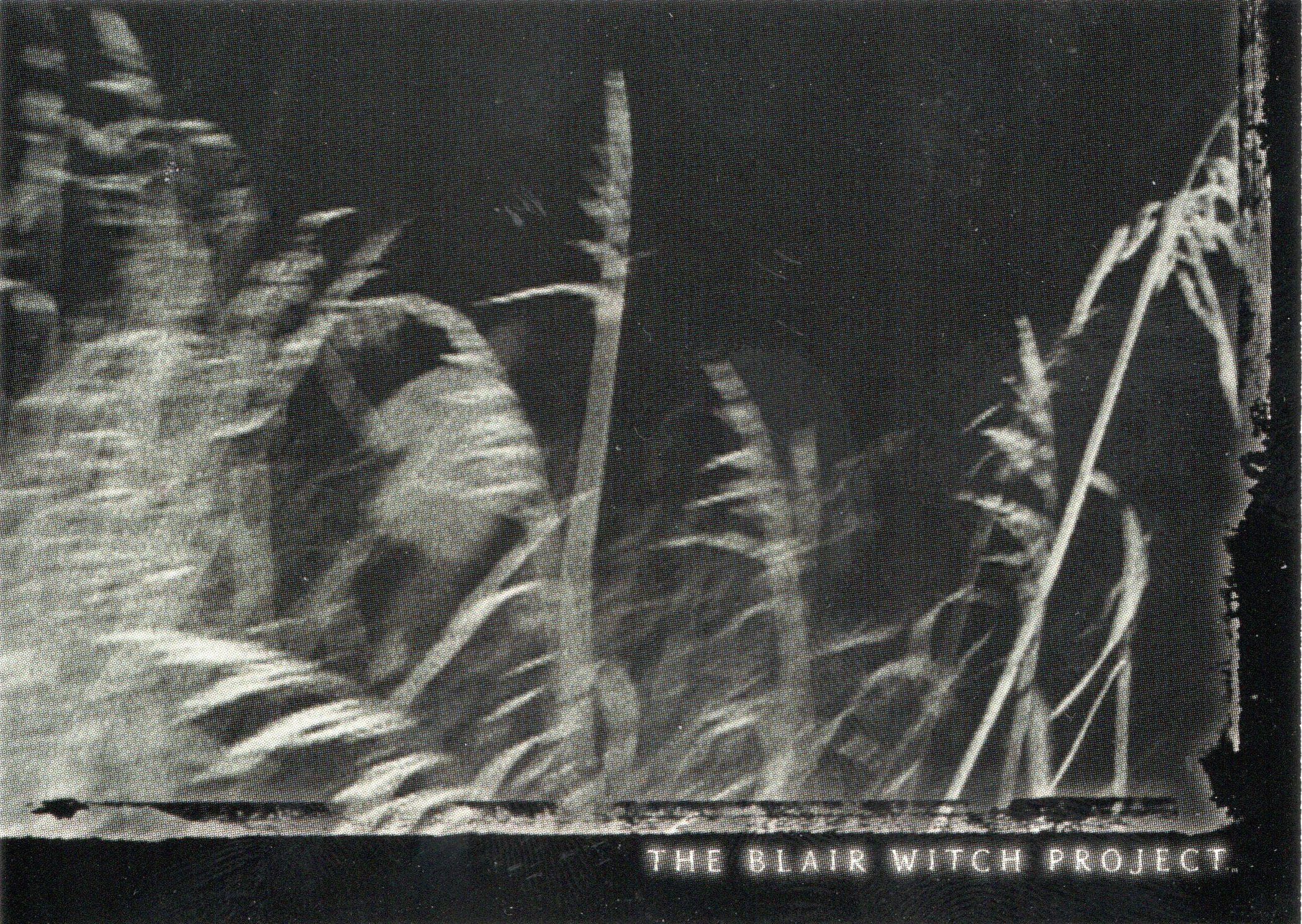
The Blair Witch Project (1999) - Trading Card #54

Heather's Journal 10.26.94 Part 1

Breakdowns. Exhaustion. A giant circle. We hiked 11 hours today in a giant circle. We have no food. Hungry. Despairing. Exhausted. Hating and loving each other extremely and alternately all day long. About to get to sleep now. Sure. After what happened last night. Those children's voices. Fear and exhaustion. Which on will win? I am praying for exhaustion. Whatever comes, comes. We sleep, it wakes us... I am avoiding the subject of my fear... As long as I keep shooting, I feel like all of this has a purpose. Maybe not at the moment but eventually. Shooting is only the way to make this situation good for something as soon as we get out of here... 

Thursday, May 29, 2025

The Cabin in the Woods (2012) - Soundtrack


As much as I love and enjoy The Cabin in the Woods, there is little I have to say about David Julyan's score for the film. Which is probably by design.

I can, and will, say that I like elements of the score a great deal. Those elements are why I bought the soundtrack, after all.

However there are large swaths of the score that, while offering up a plethora of ominous and moody underscore for the tongue-in-cheek horrors that are playing out across the screen, lack a thematic identity or motif.

Which brings me back to that 'by design' comment I made at the start of this collection catalog post. 

My formative years were awash with all manner of iconic works that were composed by the likes of Jerry Goldsmith, John Williams, Ennio Morricone, Lalo Schifrin, and even John Carpenter. It was a time when theme and motif were considered important aspects of cinematic storytelling.

Now, however, that approach is considered attention seeking showboating and, according to the late Douglass Fake, is actively discouraged by some producers during post-production. Film music, over the last two decades, has been made to move toward being an unobtrusive soundscape rather than being an identifiable element of the film. So it goes.

Julyan's score is a splendid example of this approach. While there are flashes and flourishes of theme and motif splashed throughout the score, more often than not the score comes across as something meant to be sensed more than heard. Not that there is any wrong with that, of course.

With no liner notes to quote or draw upon to identify and name the flash and flourishes, here is what my untrained ear notices whenever I give this CD a spin...

Track 1: In the Beginning... underscores artistic renditions of human sacrifice appearing in spreading pools of blood while production credits appear. It ends abruptly with a smash cut to the tonally disparate opening scene.

In the Beginning...'s phrasing returns at the end of Track 15: An Lo! Fornicus, which underscores the moment where Dana (Kristen Connolly), having grasped that they were made to choose how they die, loses her shit as the jaw-dropping scope of the potential choices is revealed to the audience. Beautiful, just beautiful.

Track 2: The Cabin in the Woods underplays the group departure from the gas station, their entrance onto the 'Killing Floor,' and arrival at the titular location. There is an aching melancholy to this mood piece that I really, really appreciate.

I'm going to jump forward to Track 6: The Cellar, where all the horror trope death traps await their discovery and choosing. The tract ends on a dramatic build heard as the group enters into an unwitting race to see which horror will be unleashed upon them. I love that bit.

Track 7: The Diary of Patience Buckner punctuates the reading of the latin passage in said diary and the resurrection of the Zombie Redneck Torture Family. Which is a completely different species than zombies, as you should know.

You can hear Track 8: Hadley's Lament more clearly on this album than in the actual film. A perfect example of what it means to be sensed and not heard. Hadley's Lament does make an audible return in Track 17: Herald the Pale Horse, when Hadley (Bradley Whitford) comes face-to-face with the merman he had lamented earlier about never being able to see. Another wonderful callback.

Track 9: We're Not The Only Ones Watching is the underscore for the film's first kill sequence.

Track 12: The Cabinets Will Have To Wait underplays the race against time for Sitterson (Richard Jenkins) to close the tunnel before the surviving members of the sacrifice group can escape. This energetic phrase makes a robust return in Track 16: 420, when the system is purged and all Hell breaks loose.

Track 13: For Jules introduces a heroic phrase that gets dramatically cut off when Curt hits the simulation wall and falls to his death. This phrase returns at the end of Track 21: Youth and underplays the rising of the angered Old Ones. It also gets dramatically cut off, this time by a smash cut to the end credits and the song Lost by Nine Inch Nails.

Wow. Although I started this post thinking I did not have all that much to say, turns out I was wrong. I also want to watch The Cabin in the Woods again. Go figure.

Poison Ivy (1992) - Newspaper Ad [Oakland Tribune - May 29, 1992]


I remember this causing a bit of an uproar when it was released. When I finally saw it on Cinemax or The Movie Channel or HBO, I thought it was... okay, but nothing all that special. So it goes.

Alien (1979) - Trading Card #51


Wednesday, May 28, 2025

Parasite (1982) - Newspaper Ad [San Francisco Examiner - May 28, 1982]


The lower left corner of this ad states that Parasite is screening at the Southland Cinema in Hayward. That is where I saw it. On its opening weekend, no less. I would have been all of 14 at the time and, even then, felt the movie was a turgid and unimpressive slog to sit through. I wanted more of the titular creature, which one critic described as looking like "a Big Mac with teeth," and less of all the wooden performances and meandering padding. So it goes.

The Blair Witch Project (1999) - Trading Card #53

Attacked

The muffled laughter of little children awakened the terrified filmmakers. Reflexively turning on their cameras, they huddled in the tent, Heather quickly pulling on her pants. Then, suddenly, the entire tent around them began to shake violently. All three occupants took flight, running headlong into the woods. Somehow regrouping, they eventually calmed themselves down, turned out their camera lights, and waited anxiously for morning to come. 

Tuesday, May 27, 2025

Burnt Offerings (1976) - Soundtrack


While my first viewing of Burnt Offerings (1976) proved a memorable one, with several sequences scaring the ever-living daylights out of me, Robert Cobert's atmospheric score did not register. This might have to do with the score being so perfectly integrated within the film that the music is far more often felt than actually heard. Does that make sense?

Jeff Thompson's liner notes declare Cobert's score for Burnt Offerings to be "one of his finest scores of the 1970s." Perhaps. I do not feel that I am well-versed enough in the man's output to offer an agreement or a contrary opinion. But I can and do agree that Cobert's score is excellent.

Conducting a 20-piece orchestra, Cobert deftly employs "minor seconds, string tremolos, repetitive figures, and crescendos to dissonant cords with abrupt releases." At least that is what Thompson wrote in his liner notes. He also calls Cobert a "master of dissonance," which is used "effectively but never unpleasantly to the untrained ear." Being a person with an untrained ear, I can and do heartily concur with that.

Track 27 of this 2011 release features an unused alternate Main Theme that is quite different from the ominous music used in the film. "I wanted to start the movie upbeat," Cobert remembers in the liner notes, "like nothing bad was going to happen to the family."

Whether or not that "jaunty, duple-rhythm" alternate Main Theme would have worked in the film will always be up for artistic debate. I can see and appreciate both sides of the argument for its use or its being left on the cutting room floor. I also greatly appreciate being given the opportunity to actually hear it.

The Horror of Party Beach (1964) / The Curse of the Living Corpse (1964) - Newspaper Ad [Oakland Tribune - May 27, 1964]


I share with zero embarrassment that, as a child, the first time or two that I watched The Horror of Party Beach the movie scared the snot out of me. Today it is hard to watch the movie and not have a plethora of wisecracks from Mystery Science Theater 3000 spring to mind.

Whether you watch the riffed version of The Horror of Party Beach or not, you will have a good time. Of all the beach party-monster movie mash ups that were birthed in the 1960s, this one might be the best of the bunch.

Being a huge fan of Roy Scheider, thanks to Jaws, Jaws 2, The French Connection, The Seven Ups, Sorcerer, All That Jazz, Still of the Night, Blue Thunder, and 52 Pick-Up, I feel a bucket list necessity to watch The Curse of the Living Corpse, as it was the actor's first ever film. I know it is not supposed to be very good, but watch it I will... some day.